A live video buffer which uses the Video for Linux 2 (V4L2) API. More...
#include <v4lbuffer.h>
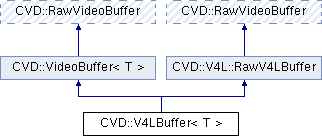
Inheritance diagram for CVD::V4LBuffer< T >:
Classes | |
| struct | V4LFrame |
Public Member Functions | |
| V4LBuffer (const std::string &dev, ImageRef size, int input=-1, bool fields=false, int frames_per_second=0, bool verbose=0) | |
| virtual ImageRef | size () |
| virtual VideoFrame< T > * | get_frame () |
| virtual void | put_frame (VideoFrame< T > *f) |
| virtual bool | frame_pending () |
| virtual double | frame_rate () |
| int | num_buffers () |
Detailed Description
template<class T>
class CVD::V4LBuffer< T >
A live video buffer which uses the Video for Linux 2 (V4L2) API.
A replacement for the (deprecated?) V4L2Buffer
Definition at line 200 of file v4lbuffer.h.
Member Function Documentation
template<class T >
| virtual void CVD::V4LBuffer< T >::put_frame | ( | VideoFrame< T > * | f | ) | [inline, virtual] |
Tell the buffer that you are finished with this frame.
Typically the VideoBuffer then destroys the frame.
- Parameters:
-
f The frame that you are finished with.
Implements CVD::VideoBuffer< T >.
Definition at line 219 of file v4lbuffer.h.
template<class T >
| virtual bool CVD::V4LBuffer< T >::frame_pending | ( | ) | [inline, virtual] |
Is there a frame waiting in the buffer? This function does not block.
See is_live and is_flushable.
Implements CVD::RawVideoBuffer.
Definition at line 229 of file v4lbuffer.h.
The documentation for this class was generated from the following file:
- cvd/Linux/v4lbuffer.h